top of page
The Youth Journal Club Project
Quick Notes: Randomized Controlled Trials (RCTs)- By Vaishnav Nair
● Prospective study - cohort is tracked over time and data is collected
● Measures effectiveness of new interventions/treatments
● Randomization - assigning participants to treatment or control groups based on chance
○ Observed and unobserved characteristics are balanced among both groups
○ Reduces bias
○ Helps better determine causality because any differences in outcome are more likely to be attributed to the intervention
● Steps to design:
○ 1. Population, interventions, and outcomes of interest are determined
○ 2. Power calculation - number of participants needed to reliably determine if a relationship exists between the intervention and outcome of interest
○ 3. Participants are recruited and randomly assigned to either the comparison or treatment group.
■ Concealment - the participant in unaware of which group they will be a part of
■ A computer will often determine the groups to minimize bias; doctors and nurses are often unaware of which participants are in which group
● Subtypes:
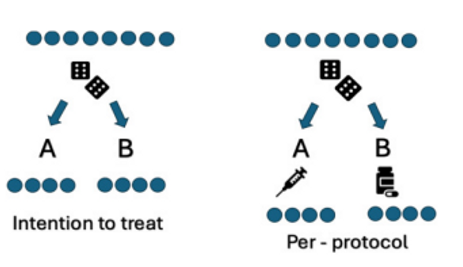
○ Intention-to-treat analysis (ITT): subjects analyzed in the groups they were placed into; often regarded as least biased
○ Per-protocol: one those who completed the treatment are analyzed and based on what treatment they received
○ Others exist but are less common
● Drawbacks:
○ High costs (both in time and money due to nature of tracking over time)
○ Participants may not be generalized as a representation of the population being studied
○ Lack of follow up

bottom of page